
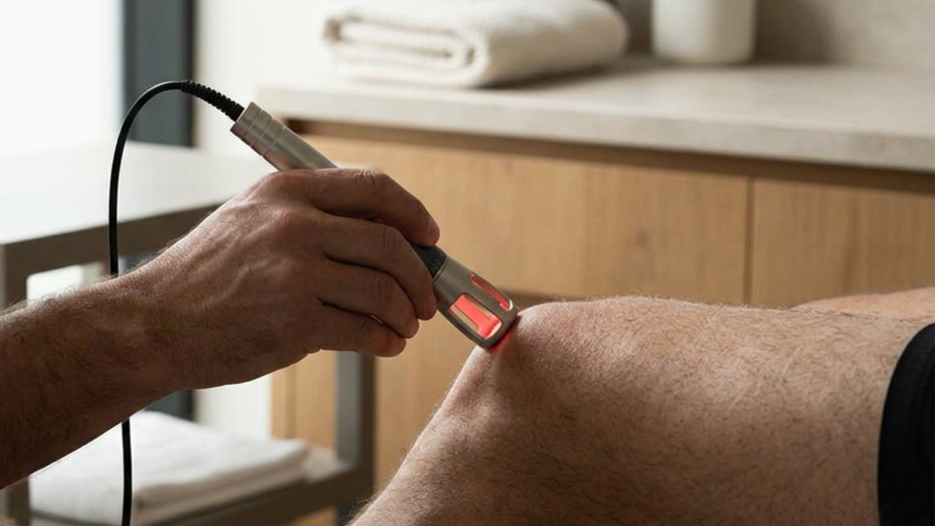
K-Laser is one of the treatments our clinical team uses most often at our Covent Garden clinic. Here, we explain how K-Laser therapy works, what the evidence tells us, and what you can expect if we recommend it as part of your treatment plan.
At Midtown Wellness, K-Laser is one of the treatments our team reach for most often alongside hands-on care, a Class IV therapeutic laser used to treat musculoskeletal (MSK) conditions such as tendinopathy, osteoarthritis and soft-tissue injury. It works through photobiomodulation: light energy at specific wavelengths is absorbed by cells, where it's thought to influence mitochondrial activity, circulation and inflammatory signalling, supporting the tissue's own repair process.
How the laser actually works
The device we use, a multi-wavelength Class IV K-Laser, emits several wavelengths at once — commonly across the 660–970nm red and near-infrared range — because tissue absorbs different wavelengths at different depths. Combining wavelengths this way is designed to reach superficial skin as well as deeper muscle, tendon and joint tissue within a single, short session.
Clinically, the working theory is that this light exposure:
Stimulates cellular metabolism and ATP production
Increases local microcirculation and delivery of oxygen and nutrients
Modulates inflammatory mediators
Supports collagen synthesis and tissue remodelling
A 2026 systematic review pooling 53 clinical studies (roughly 2,800 patients) found that photobiomodulation protocols using red-to-near-infrared light reduced mean pain scores by around a third across knee osteoarthritis, tendinopathy, low back pain and postoperative pain populations — a meaningful effect, though the review pooled a wide range of conditions and dosing protocols rather than isolating any single device or indication.
Conditions it's commonly used for
We most commonly recommend K-Laser as part of a treatment plan for:
Tendinopathies — Achilles, patellar, tennis and golfer's elbow
Plantar fasciitis
Osteoarthritic joint pain, particularly the knee
Neck and lower back pain
Repetitive strain injuries
Acute sports injuries and post-surgical rehabilitation
Musculoskeletal pain during pregnancy, as an adjunct, with appropriate clinical judgement
Frequently asked questions
Is K-Laser therapy painful?
Most patients feel a mild, soothing warmth rather than pain during a Class IV session.
How many sessions are needed for musculoskeletal pain?
Acute injuries often respond within around four sessions. Chronic conditions such as osteoarthritis may need a longer course — sometimes twelve sessions or more — typically delivered a couple of times a week at first.
Who Can Benefit from K-Laser Therapy?
K-Laser therapy is a versatile, non-invasive treatment that can be adapted to suit a wide range of patients, conditions and treatment goals. Treatment settings can be tailored to the individual, taking into account the condition being treated, the affected area and the stage of recovery.
It may be particularly useful for people managing musculoskeletal pain, inflammation, sports injuries and longer-term conditions such as osteoarthritis. Depending on the individual, laser therapy can be used as a standalone treatment or alongside physiotherapy, osteopathy, chiropractic and other forms of clinical care.
How Many K-Laser Therapy Sessions Will I Need?
The number of sessions depends on the condition, its severity and how long symptoms have been present. Acute conditions may require around 4 sessions, while chronic or persistent problems may benefit from more treatments.
Where appropriate, treatment may initially be recommended twice a week, with the frequency adjusted according to your progress and clinical response.
At your initial assessment, your practitioner will discuss whether laser therapy is suitable for you and recommend a treatment plan based on your individual needs.